Scenario:
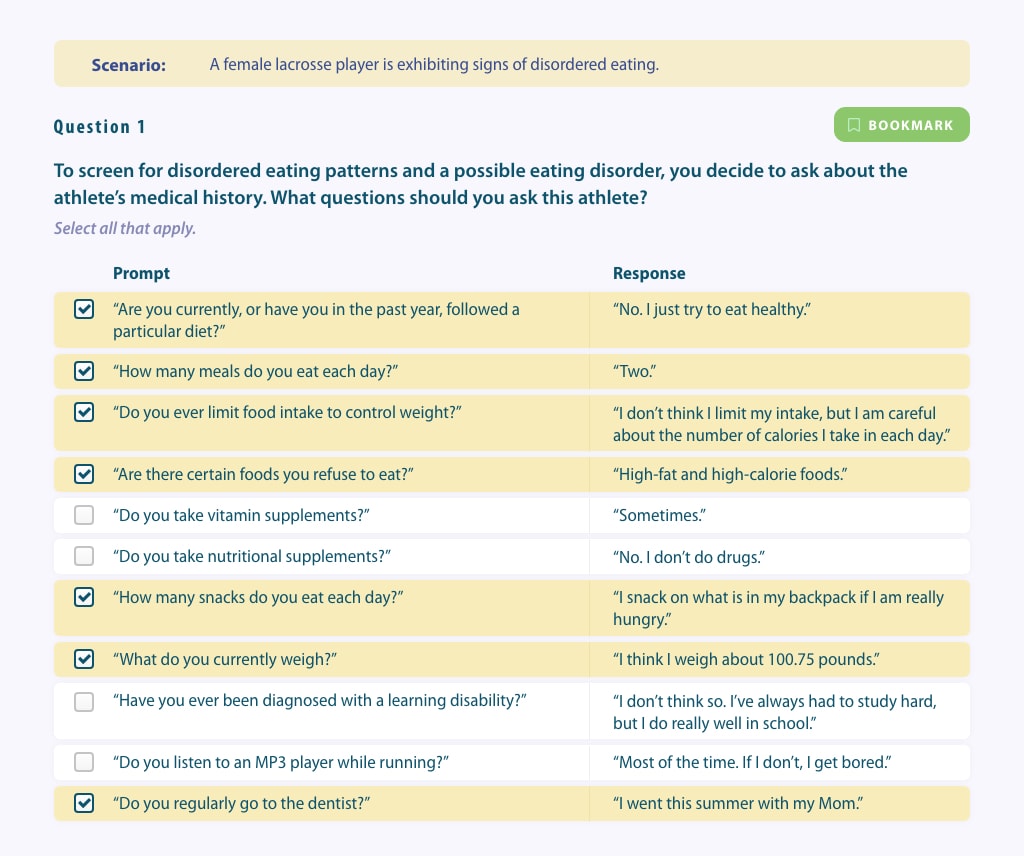
Question 1
Select all that apply.
Prompt
Response
"Are you currently, or have you in the past year, followed a particular diet?"
"No. I just try to eat healthy."
"How many meals do you eat each day?"
"Two."
"Do you ever limit food intake to control weight?"
"I don't think I limit my intake, but I am careful about the number of calories I take in each day."
"Are there certain foods you refuse to eat?"
"High-fat and high-calorie foods."
"Do you take vitamin supplements?"
"Sometimes."
"Do you take nutritional supplements?"
"No. I don't do drugs."
"How many snacks do you eat each day?"
"I snack on what is in my backpack if I am really hungry."
"What do you currently weigh?"
"I think I weigh about 100.75 pounds."
"Have you ever been diagnosed with a learning disability?"
"I don't think so. I've always had to study hard, but I do really well in school."
"Do you listen to an MP3 player while running?"
"Most of the time. If I don't, I get bored."
"Do you regularly go to the dentist?"
"I went this summer with my Mom."
Scenario:
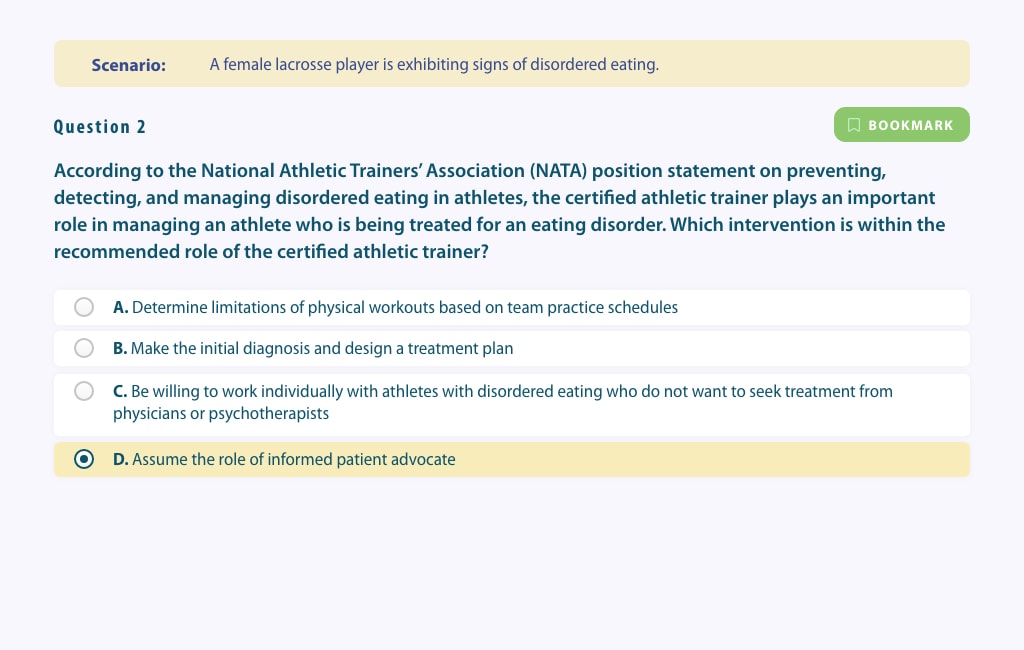
Question 2
Determine limitations of physical workouts based on team practice schedules
Make the initial diagnosis and design a treatment plan
Be willing to work individually with athletes with disordered eating who do not want to seek treatment from physicians or psychotherapists
Assume the role of informed patient advocate
Scenario:
Question 3

Click to enlarge
Approach the athlete with sensitivity and respect while adhering to disclosure regulations regarding patient confidentiality
Indicate specific observations of concern
Expect denial, anger, or resistance
Have experts readily accessible for consultation and/or timely referral
Scenario:
Question 4
Select four.
Refusal to maintain body weight at or above minimally normal weight for age and height
Intense fear of gaining weight or becoming fat even though underweight
Disturbance in the way one’s body weight or shape is experienced, undue influence of body weight or shape on self-evaluation, or denial of the seriousness of the current low body weight
Absence of at least three consecutive menstrual cycles
Severe mood shifts and feelings of guilt about eating
Wearing baggy clothes to disguise thin appearance
Preferring to eat in isolation
Body weight less than 85% of expected weight
Scenario:
Question 5
Absence of self-starvation practices
Maintenance of regular menstrual cycle
Absence of distorted body image
Absence of mood shifts and fear of becoming obese
Willingness to discuss eating practices
|
Question Number |
Your Score |
Possible Score |
Answer Key |
|---|---|---|---|
|
1 |
0 |
7 |
|
|
2 |
0 |
1 |
|
|
3 |
0 |
1 |
|
|
4 |
0 |
4 |
|
|
5 |
0 |
1 |
|
|
Total Points |
0 |
14 |
|
|
Percentage |
|
||