Focused Testlet 21

RETURN TO MENU
TIME: 00:00:00
PREV

Question 1 of 5

NEXT

Scenario:

You have volunteered to be the medical director for a local marathon to be held July 4th. The typical weather for the weekend of July 4th is 80°F with high humidity. The race’s executive committee will be producing an informational brochure all race participants will receive on registering for the race. You have been asked to address sports medicine issues in the brochure.

Question 1

BOOKMARK
You have chosen to include information about calculating sweat rate in the informational brochure. Which statement regarding an athlete’s sweat rate is correct?

Sweat rate is calculated as pre-exercise body weight minus post-exercise body weight, taking into account volume of fluid intake and urine production

The average sweat rate ranges from 3 to 3.5 L/hr

Sweat rate is equal to twice the amount of urine produced per hour

Sweat rate is independent of the athlete’s acclimatization status

Scenario:

You have volunteered to be the medical director for a local marathon to be held July 4th. The typical weather for the weekend of July 4th is 80°F with high humidity. The race’s executive committee will be producing an informational brochure all race participants will receive on registering for the race. You have been asked to address sports medicine issues in the brochure.

Question 2

BOOKMARK
You have decided to include information about fluid replacement options in the informational brochure. What information should you include about fluid replacement beverages?

Select all that apply.

Include sodium chloride in a replacement beverage if the training session exceeds 4 hours in duration or if it occurs during the initial days of a period of hot weather

A beverage containing 0.3 to 0.7 g/L of sodium can offset salt losses in sweat

A cool beverage of 10°C to 15°C (50°F to 59°F) is recommended

A carbohydrate should be included in a fluid replacement beverage consumed during exercise if the session lasts longer than 45 minutes or is very intense

Carbohydrate beverages should have a concentration of less than 8%

Rehydration beverages should contain water, a carbohydrate, and electrolytes and should ideally be consumed within 2 hours after exercise

Beverages consumed at a temperature slightly above room temperature are recommended to minimize gastrointestinal discomfort

Fruit juices are a viable choice for fluid replacement during exercise

Scenario:

You have volunteered to be the medical director for a local marathon to be held July 4th. The typical weather for the weekend of July 4th is 80°F with high humidity. The race’s executive committee will be producing an informational brochure all race participants will receive on registering for the race. You have been asked to address sports medicine issues in the brochure.

Question 3

BOOKMARK
You have decided to include information on acclimatizing to the heat in the informational brochure.  What information should you include in the brochure?

Select all that apply.

It will take approximately 10 to 14 days to acclimatize

It will take 3 to 5 days to acclimatize

Exposure to the heat should be gradual; begin with short workouts in the morning and evening hours

Recalculate sweat rate after acclimatization to ensure adequate fluid intake

Women may acclimatize faster than men because they are more physiologically efficient in body temperature regulation

Due to their larger muscle mass, men will acclimatize in fewer days than women

When acclimatizing to the heat, progress the intensity and duration of workouts in the heat using strenuous interval training work and continuous exercise bouts

After acclimatization, train for 1 to 2 hours in environmental conditions similar to those anticipated for race day

Scenario:

You have volunteered to be the medical director for a local marathon to be held July 4th. The typical weather for the weekend of July 4th is 80°F with high humidity. The race’s executive committee will be producing an informational brochure all race participants will receive on registering for the race. You have been asked to address sports medicine issues in the brochure.

Question 4

BOOKMARK
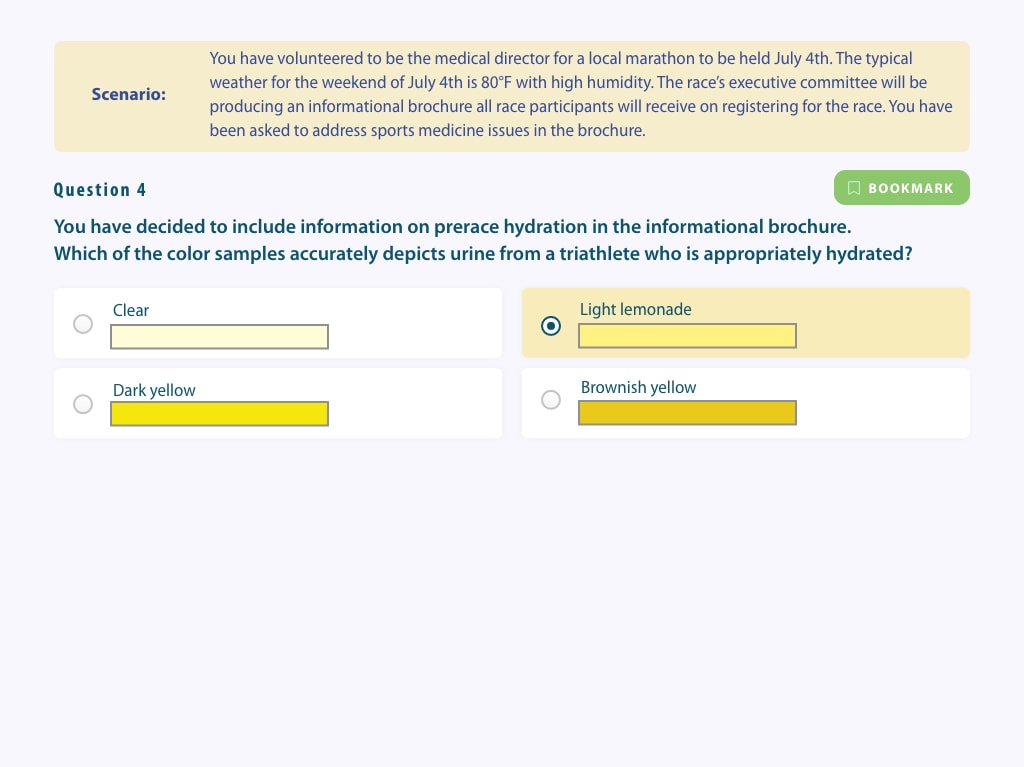
You have decided to include information on prerace hydration in the informational brochure. Which of the color samples accurately depicts urine from a triathlete who is appropriately hydrated?

Clear

Light lemonade

Dark yellow

Brownish yellow

Scenario:

You have volunteered to be the medical director for a local marathon to be held July 4th. The typical weather for the weekend of July 4th is 80°F with high humidity. The race’s executive committee will be producing an informational brochure all race participants will receive on registering for the race. You have been asked to address sports medicine issues in the brochure.

Question 5

BOOKMARK
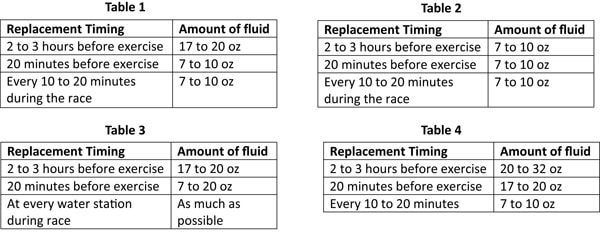
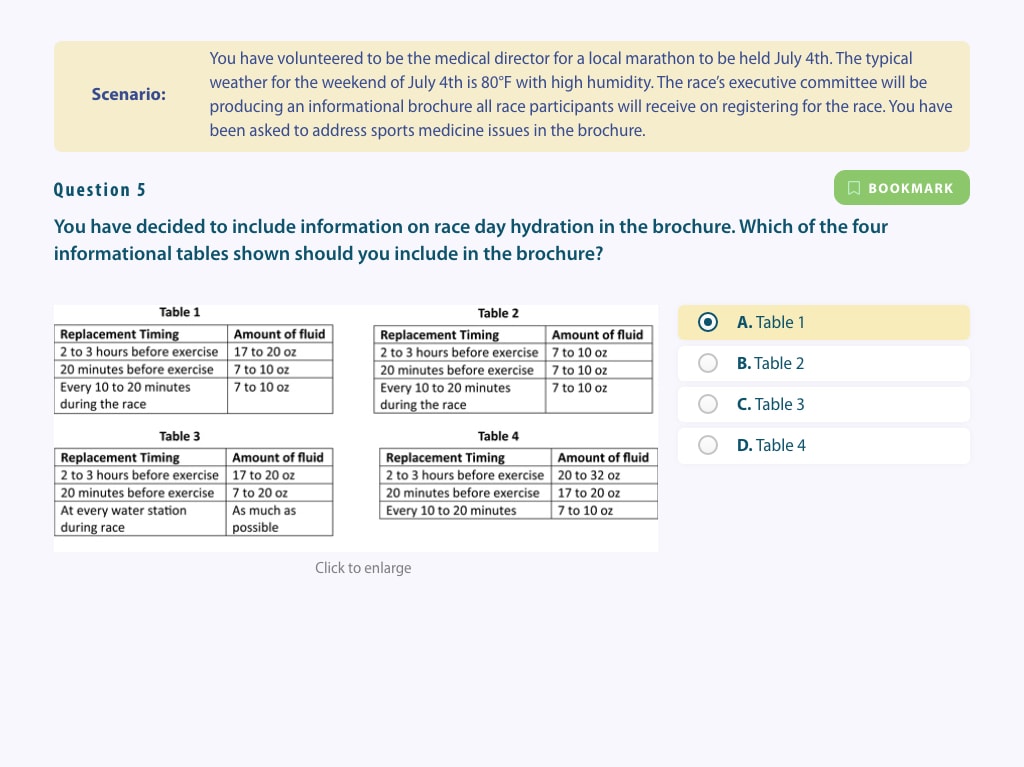
You have decided to include information on race day hydration in the brochure. Which of the four informational tables shown should you include in the brochure?

Click to enlarge

Table 1

Table 2

Table 3

Table 4

STUDENT NAME:

DATE COMPLETED:

TIME TRACKED:

Question Number

Your Score

Possible Score

Answer Key

1

0

1

View Answer Key

2

0

6

View Answer Key

3

0

6

View Answer Key

4

0

1

View Answer Key

5

0

1

View Answer Key

Total Points

0

15

Percentage

PRINT RESULTS
NEXT TESTLET