Focused Testlet 31

RETURN TO MENU
TIME: 00:00:00
PREV

Question 1 of 5

NEXT

Scenario:

You are providing athletic training services for a charity tennis tournament. You are called to the court to assist a player who is sitting on the court, appears to be in distress, and is hyperventilating.

Question 1

BOOKMARK
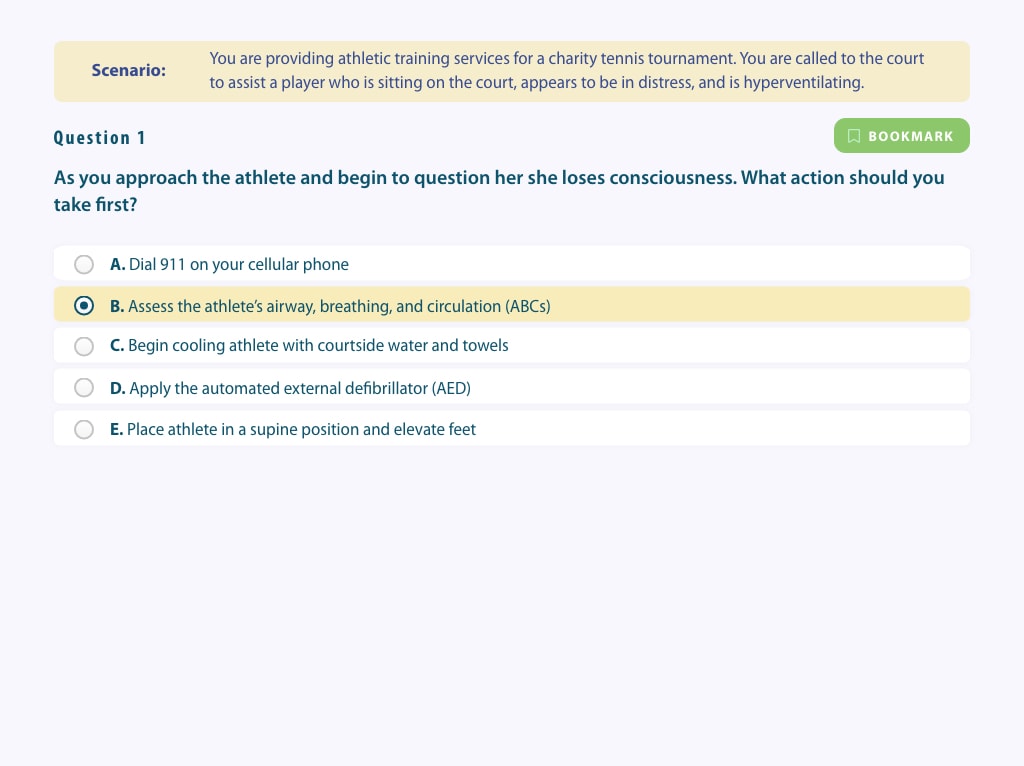
As you approach the athlete and begin to question her she loses consciousness. What action should you take first?

Dial 911 on your cellular phone

Assess the athlete’s airway, breathing, and circulation (ABCs)

Begin cooling athlete with courtside water and towels

Apply the automated external defibrillator (AED)

Place athlete in a supine position and elevate feet

Scenario:

You are providing athletic training services for a charity tennis tournament. You are called to the court to assist a player who is sitting on the court, appears to be in distress, and is hyperventilating.

Question 2

BOOKMARK
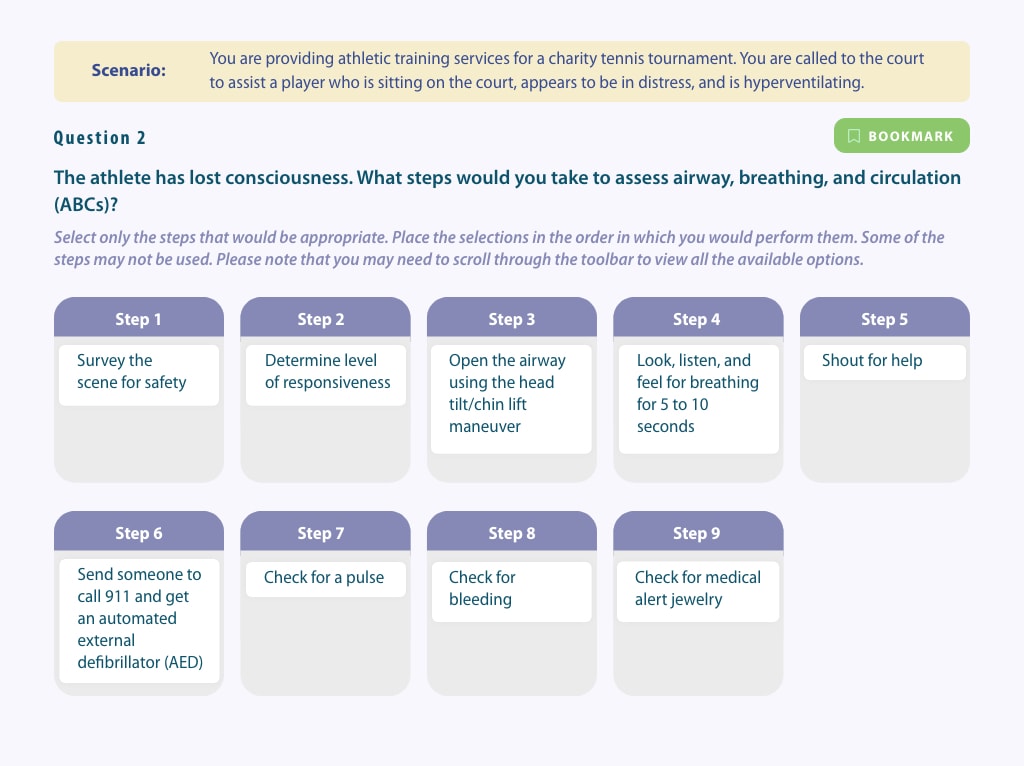
The athlete has lost consciousness. What steps would you take to assess airway, breathing, and circulation (ABCs)?

Select only the steps that would be appropriate. Place the selections in the order in which you would perform them. Some of the steps may not be used. Please note that you may need to scroll through the toolbar to view all the available options.

  • Check for a pulse

  • Determine level of responsiveness

  • Check for medical alert jewelry

  • Open the airway using the jaw thrust maneuver

  • Look, listen, and feel for breathing for 5 to 10 seconds

  • Survey the scene for safety

  • Obtain a Glasgow Coma Scale score

  • Send someone to call 911 and get an automated external defibrillator (AED)

  • Open the airway using the head tilt/chin lift maneuver

  • Check for bleeding

  • Shout for help

  • Check pupil reaction

Step 1

Step 2

Step 3

Step 4

Step 5

Step 6

Step 7

Step 8

Step 9

Scenario:

You are providing athletic training services for a charity tennis tournament. You are called to the court to assist a player who is sitting on the court, appears to be in distress, and is hyperventilating.

Question 3

BOOKMARK
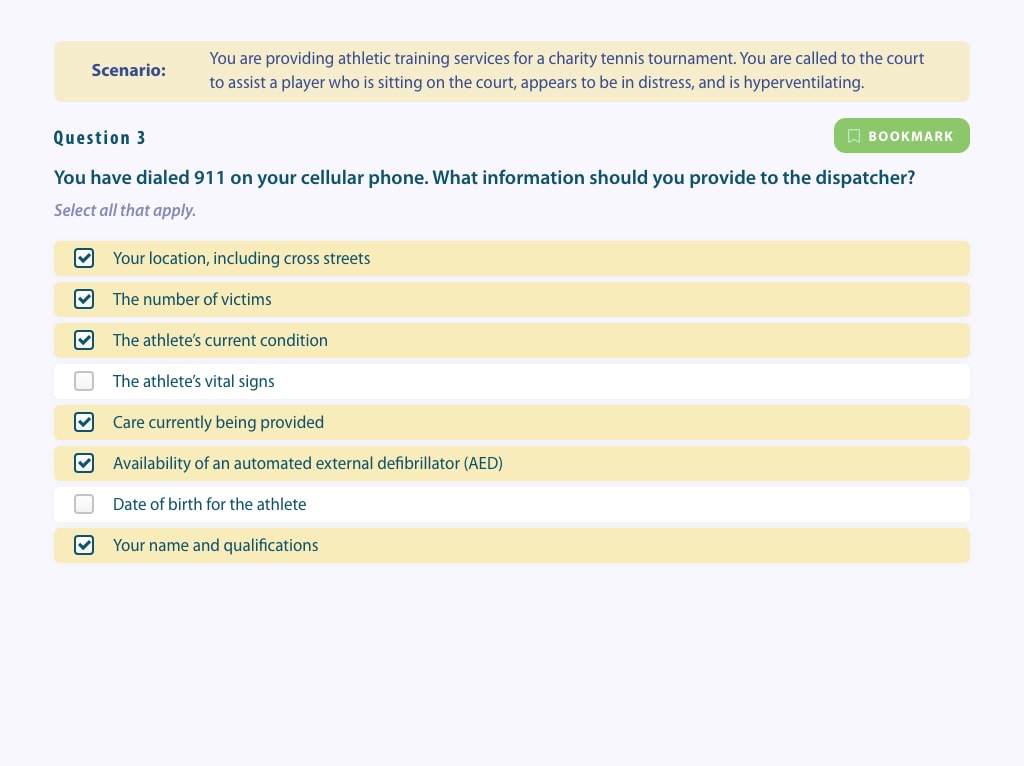
You have dialed 911 on your cellular phone. What information should you provide to the dispatcher?

Select all that apply.

Your location, including cross streets

The number of victims

The athlete’s current condition

The athlete’s vital signs

Care currently being provided

Availability of an automated external defibrillator (AED)

Date of birth for the athlete

Your name and qualifications

Scenario:

You are providing athletic training services for a charity tennis tournament. You are called to the court to assist a player who is sitting on the court, appears to be in distress, and is hyperventilating.

Question 4

BOOKMARK
While waiting for emergency medical services (EMS) to arrive, the athlete regains consciousness. What questions are most appropriate to ask this athlete?

Select all that apply.

Do you have any medical conditions?

Are you taking any medication?

What made you start feeling bad?

Has this ever happened before?

How are you feeling?

Do you know what happened?

Who is your primary care physician?

Do you think you ate enough breakfast?

Can you sit up?

How long were you unconscious?

Scenario:

You are providing athletic training services for a charity tennis tournament. You are called to the court to assist a player who is sitting on the court, appears to be in distress, and is hyperventilating.

Question 5

BOOKMARK
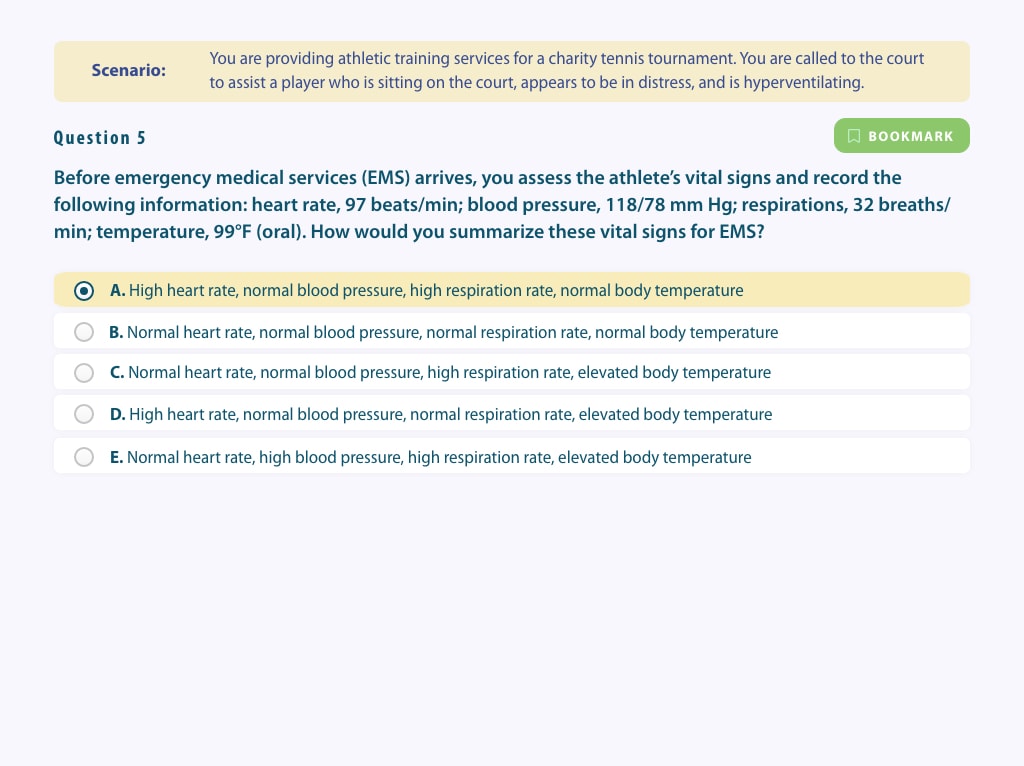
Before emergency medical services (EMS) arrives, you assess the athlete’s vital signs and record the following information: heart rate, 97 beats/min; blood pressure, 118/78 mm Hg; respirations, 32 breaths/min; temperature, 99°F (oral). How would you summarize these vital signs for EMS?

High heart rate, normal blood pressure, high respiration rate, normal body temperature

Normal heart rate, normal blood pressure, normal respiration rate, normal body temperature

Normal heart rate, normal blood pressure, high respiration rate, elevated body temperature

High heart rate, normal blood pressure, normal respiration rate, elevated body temperature

Normal heart rate, high blood pressure, high respiration rate, elevated body temperature

STUDENT NAME:

DATE COMPLETED:

TIME TRACKED:

Question Number

Your Score

Possible Score

Answer Key

1

0

1

View Answer Key

2

0

9

View Answer Key

3

0

6

View Answer Key

4

0

6

View Answer Key

5

0

1

View Answer Key

Total Points

0

23

Percentage

PRINT RESULTS
NEXT TESTLET