-
Incorporate plyometric activities for the lower extremities
-
Perform in-pool weight-bearing rehabilitation exercises
-
Perform cycling activities
-
Resume full weight-bearing locomotion as the pain subsides
-
Perform in-pool non–weight-bearing rehabilitation exercise
-
Jog on grass or a soft surface
-
Jog on a mini-trampoline
-
Jog on a treadmill at a moderate incline
-
Use an elliptical machine for cardiovascular exercise
-
Jog on a treadmill at zero incline
Scenario:
A female freshman-level intercollegiate cross country runner reports to her preparticipation physical examination in late August. She reports a history of bilateral tibial stress fractures, which occurred during high school. She admits she has been experiencing constant bilateral shin pain for 3 weeks. This bilateral tibial pain has caused her to reduce her running mileage from 60 miles to 40 miles per week.
Question 1
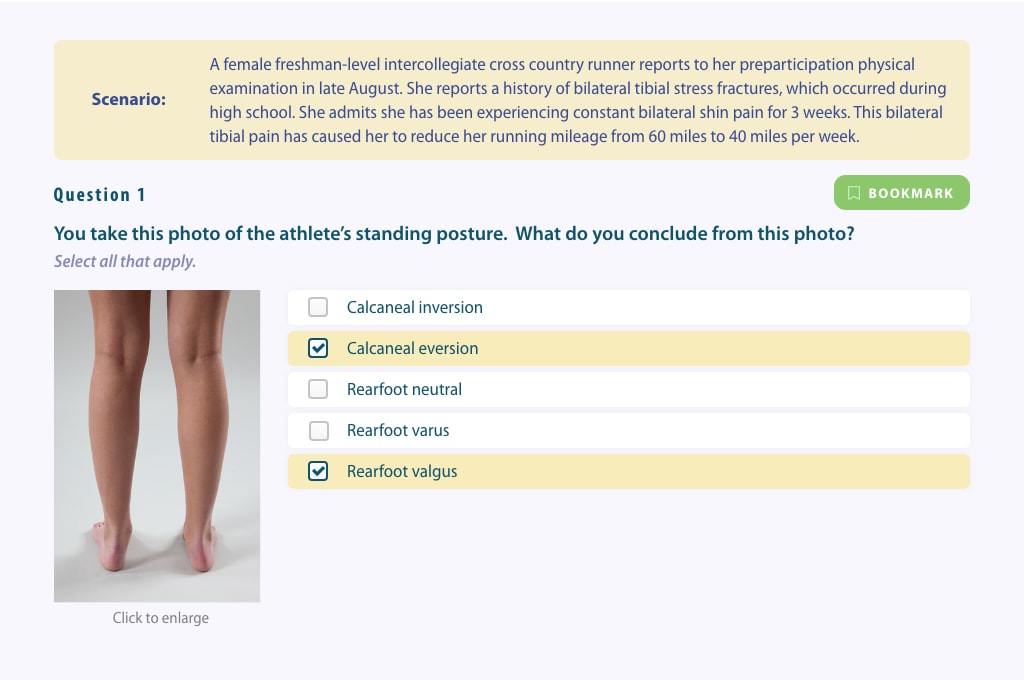
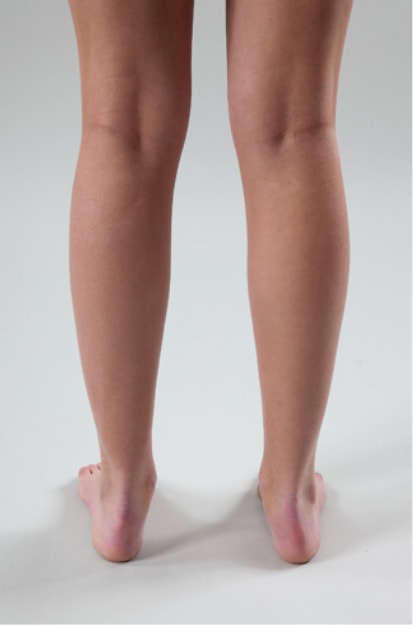
You take this photo of the athlete's standing posture. What do you conclude from this photo?
Select all that apply.
Click to enlarge
Calcaneal inversion
Calcaneal eversion
Rearfoot neutral
Rearfoot varus
Rearfoot valgus
Scenario:
A female freshman-level intercollegiate cross country runner reports to her preparticipation physical examination in late August. She reports a history of bilateral tibial stress fractures, which occurred during high school. She admits she has been experiencing constant bilateral shin pain for 3 weeks. This bilateral tibial pain has caused her to reduce her running mileage from 60 miles to 40 miles per week.
Question 2
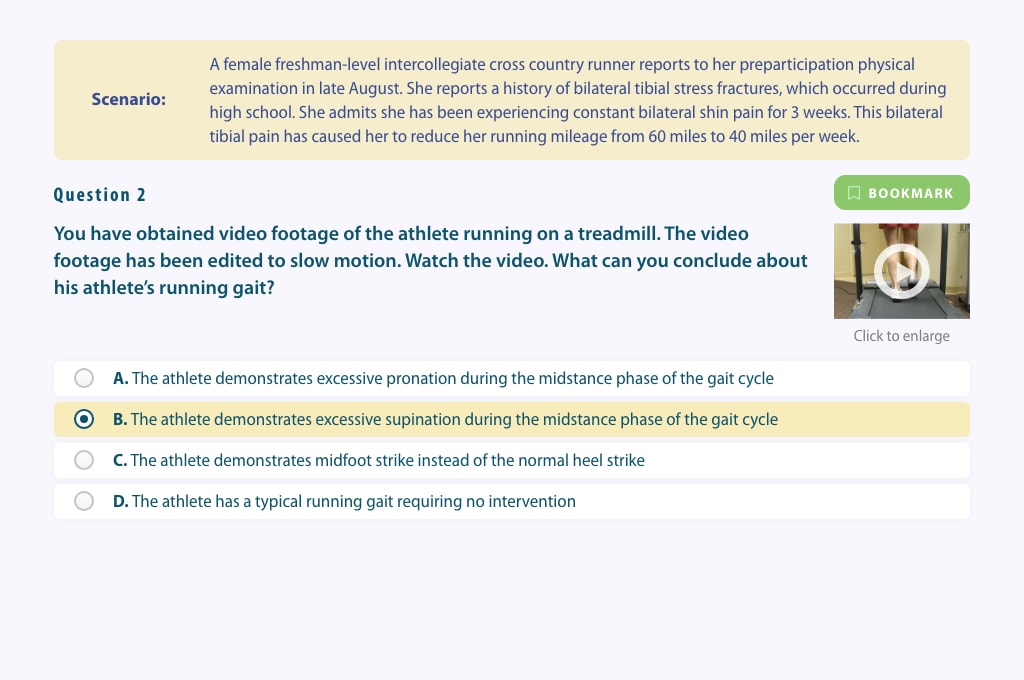
You have obtained video footage of the athlete running on a treadmill. The video footage has been edited to slow motion. Watch the video. What can you conclude about his athlete’s running gait?
Click to enlarge
The athlete demonstrates excessive pronation during the midstance phase of the gait cycle
The athlete demonstrates excessive supination during the midstance phase of the gait cycle
The athlete demonstrates midfoot strike instead of the normal heel strike
The athlete has a typical running gait requiring no intervention
Scenario:
A female freshman-level intercollegiate cross country runner reports to her preparticipation physical examination in late August. She reports a history of bilateral tibial stress fractures, which occurred during high school. She admits she has been experiencing constant bilateral shin pain for 3 weeks. This bilateral tibial pain has caused her to reduce her running mileage from 60 miles to 40 miles per week.
Question 3
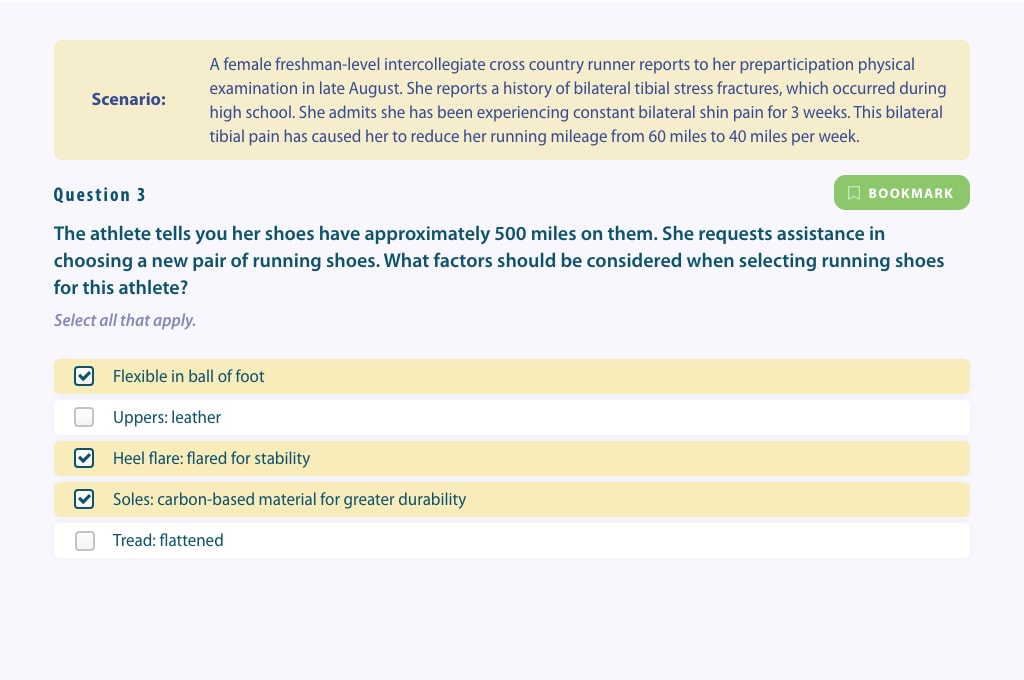
The athlete tells you her shoes have approximately 500 miles on them. She requests assistance in choosing a new pair of running shoes. What factors should be considered when selecting running shoes for this athlete?
Select all that apply.
Flexible in ball of foot
Uppers: leather
Heel flare: flared for stability
Soles: carbon-based material for greater durability
Tread: flattened
Scenario:
A female freshman-level intercollegiate cross country runner reports to her preparticipation physical examination in late August. She reports a history of bilateral tibial stress fractures, which occurred during high school. She admits she has been experiencing constant bilateral shin pain for 3 weeks. This bilateral tibial pain has caused her to reduce her running mileage from 60 miles to 40 miles per week.
Question 4
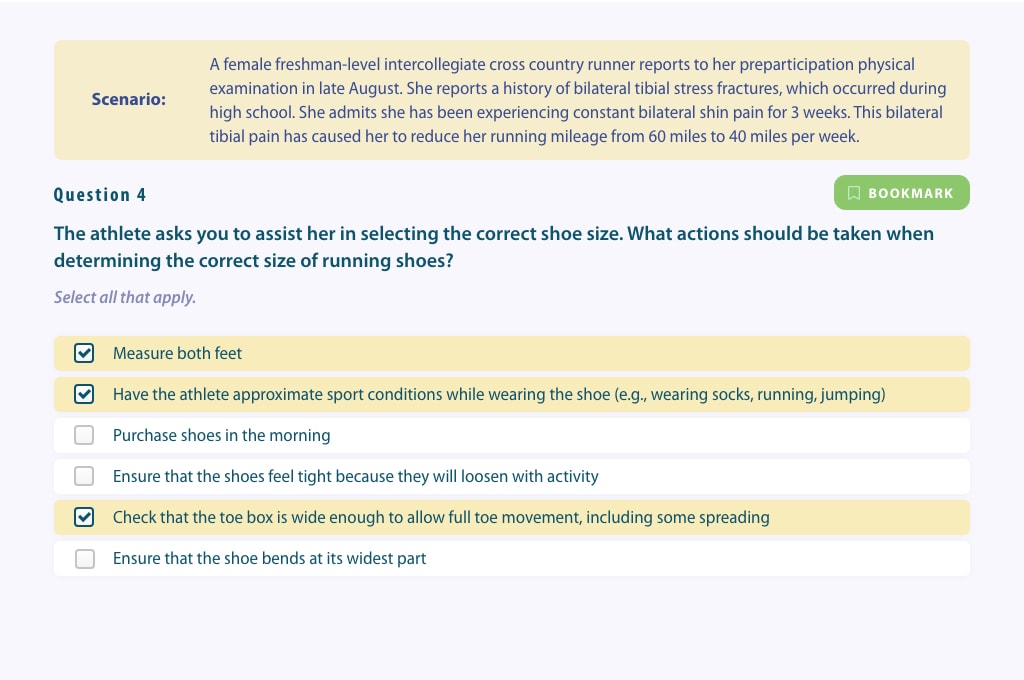
The athlete asks you to assist her in selecting the correct shoe size. What actions should be taken when determining the correct size of running shoes?
Select all that apply.
Measure both feet
Have the athlete approximate sport conditions while wearing the shoe (e.g., wearing socks, running, jumping)
Purchase shoes in the morning
Ensure that the shoes feel tight because they will loosen with activity
Check that the toe box is wide enough to allow full toe movement, including some spreading
Ensure that the shoe bends at its widest part
Scenario:
A female freshman-level intercollegiate cross country runner reports to her preparticipation physical examination in late August. She reports a history of bilateral tibial stress fractures, which occurred during high school. She admits she has been experiencing constant bilateral shin pain for 3 weeks. This bilateral tibial pain has caused her to reduce her running mileage from 60 miles to 40 miles per week.
Question 5
Based on evaluative findings, you suspect the athlete may have bilateral tibial stress fractures. The athlete is referred to the team physician for evaluation. The physician has confirmed the stress fracture diagnosis. Which activity restriction is the physician most likely to make?
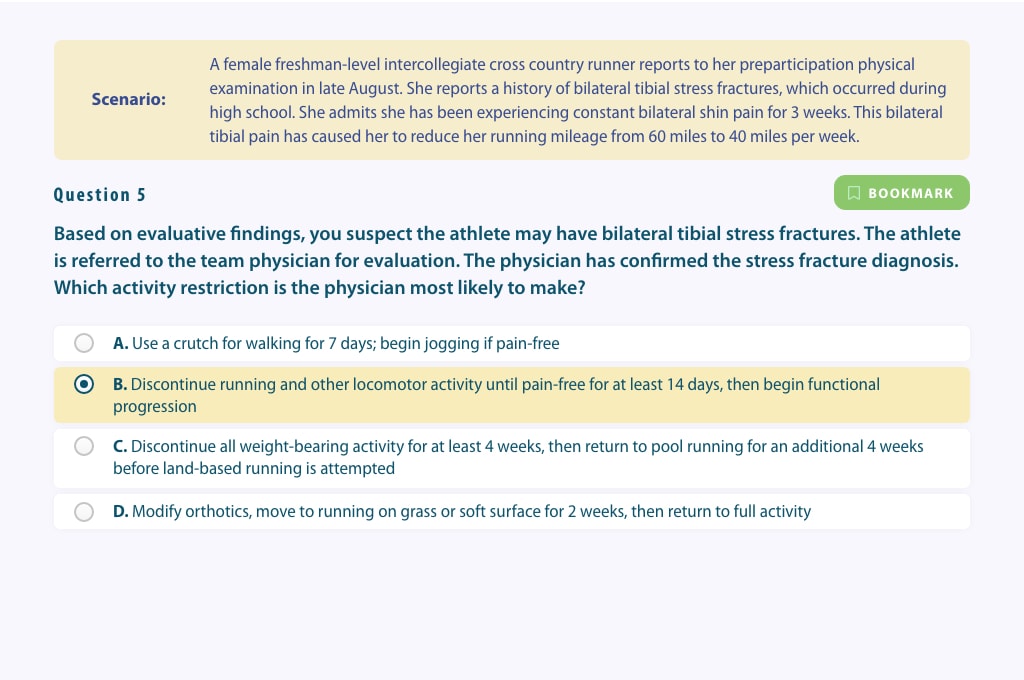
Use a crutch for walking for 7 days; begin jogging if pain-free
Discontinue running and other locomotor activity until pain-free for at least 14 days, then begin functional progression
Discontinue all weight-bearing activity for at least 4 weeks, then return to pool running for an additional 4 weeks before land-based running is attempted
Modify orthotics, move to running on grass or soft surface for 2 weeks, then return to full activity
Scenario:
A female freshman-level intercollegiate cross country runner reports to her preparticipation physical examination in late August. She reports a history of bilateral tibial stress fractures, which occurred during high school. She admits she has been experiencing constant bilateral shin pain for 3 weeks. This bilateral tibial pain has caused her to reduce her running mileage from 60 miles to 40 miles per week.
Question 6
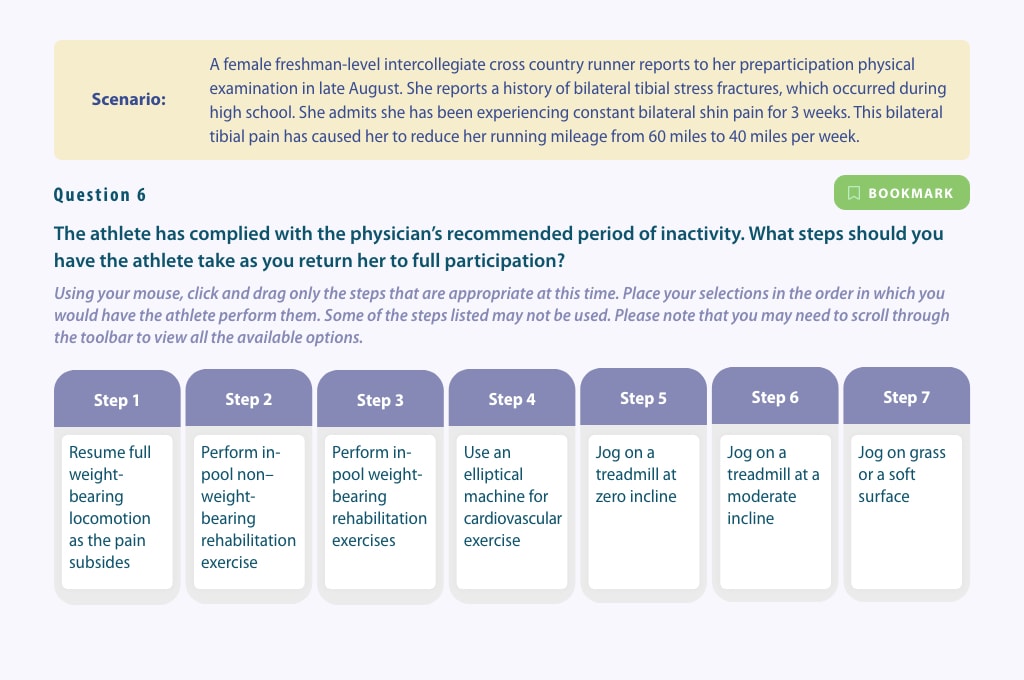
The athlete has complied with the physician’s recommended period of inactivity. What steps should you have the athlete take as you return her to full participation?
Using your mouse, click and drag only the steps that are appropriate at this time. Place your selections in the order in which you would have the athlete perform them. Some of the steps listed may not be used. Please note that you may need to scroll through the toolbar to view all the available options.
Step 1
Step 2
Step 3
Step 4
Step 5
Step 6
Step 7
|
Question Number |
Your Score |
Possible Score |
Answer Key |
|---|---|---|---|
|
1 |
0 |
2 |
|
|
2 |
0 |
1 |
|
|
3 |
0 |
3 |
|
|
4 |
0 |
3 |
|
|
5 |
0 |
1 |
|
|
6 |
0 |
7 |
|
|
Total Points |
0 |
17 |
|
|
Percentage |
|
||