Focused Testlet 23

RETURN TO MENU
TIME: 00:00:00
PREV

Question 1 of 5

NEXT

Scenario:

A diver reports to the athletic training clinic complaining of right shoulder pain during overhead weight training activities.

Question 1

BOOKMARK
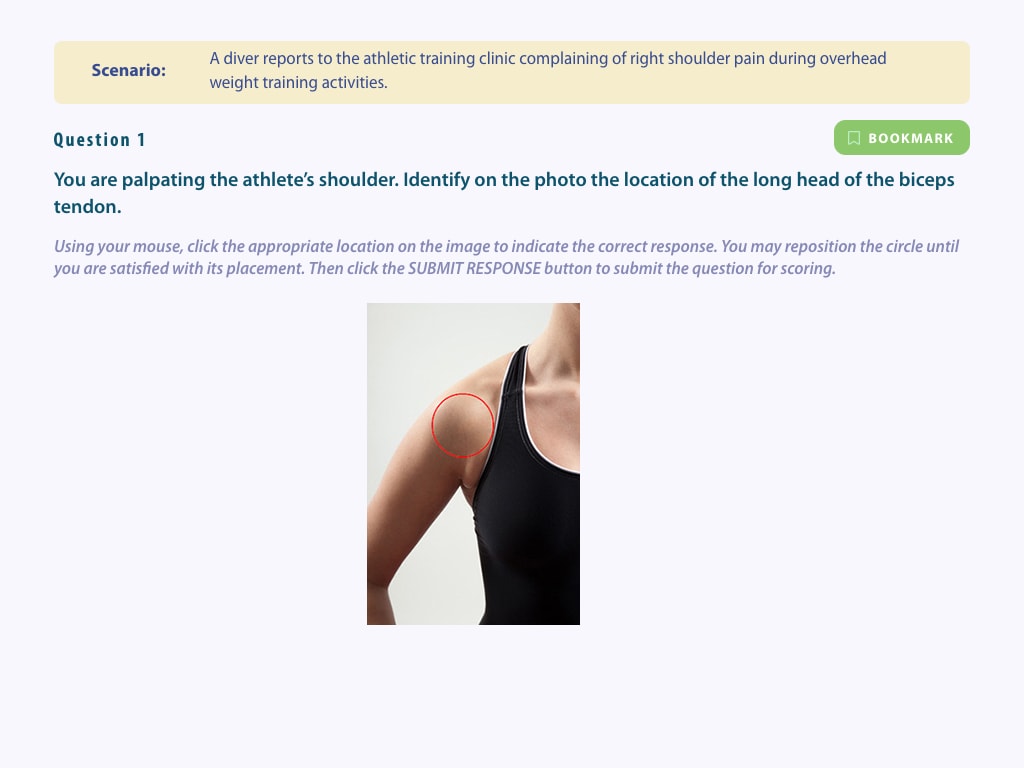
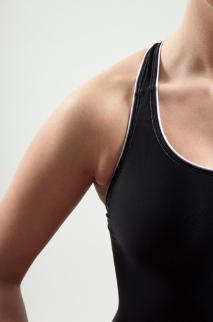
You are palpating the athlete’s shoulder. Identify on the photo the location of the long head of the biceps tendon.

Using your mouse, click the appropriate location on the image to indicate the correct response. You may reposition the circle until you are satisfied with its placement. Then click the SUBMIT RESPONSE button to submit the question for scoring.
SUBMIT RESPONSE

Scenario:

A diver reports to the athletic training clinic complaining of right shoulder pain during overhead weight training activities.

Question 2

BOOKMARK
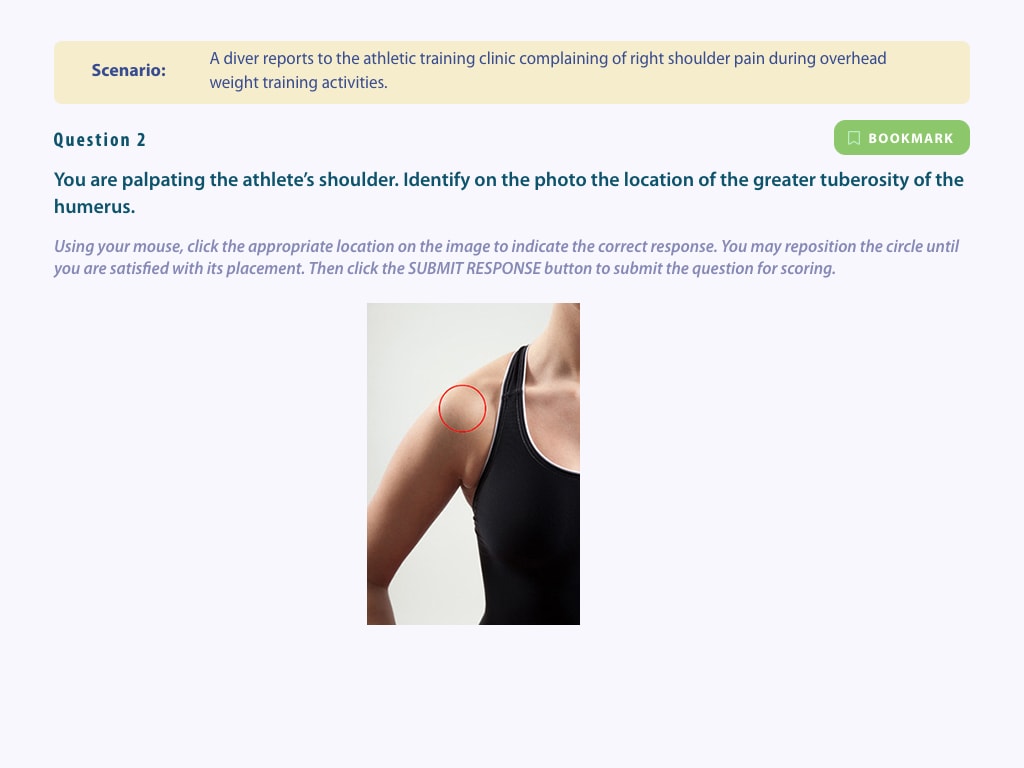
You are palpating the athlete’s shoulder. Identify on the photo the location of the greater tuberosity of the humerus.

Using your mouse, click the appropriate location on the image to indicate the correct response. You may reposition the circle until you are satisfied with its placement. Then click the SUBMIT RESPONSE button to submit the question for scoring.

SUBMIT RESPONSE

Scenario:

A diver reports to the athletic training clinic complaining of right shoulder pain during overhead weight training activities.

Question 3

BOOKMARK
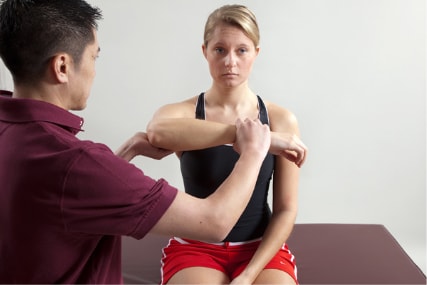
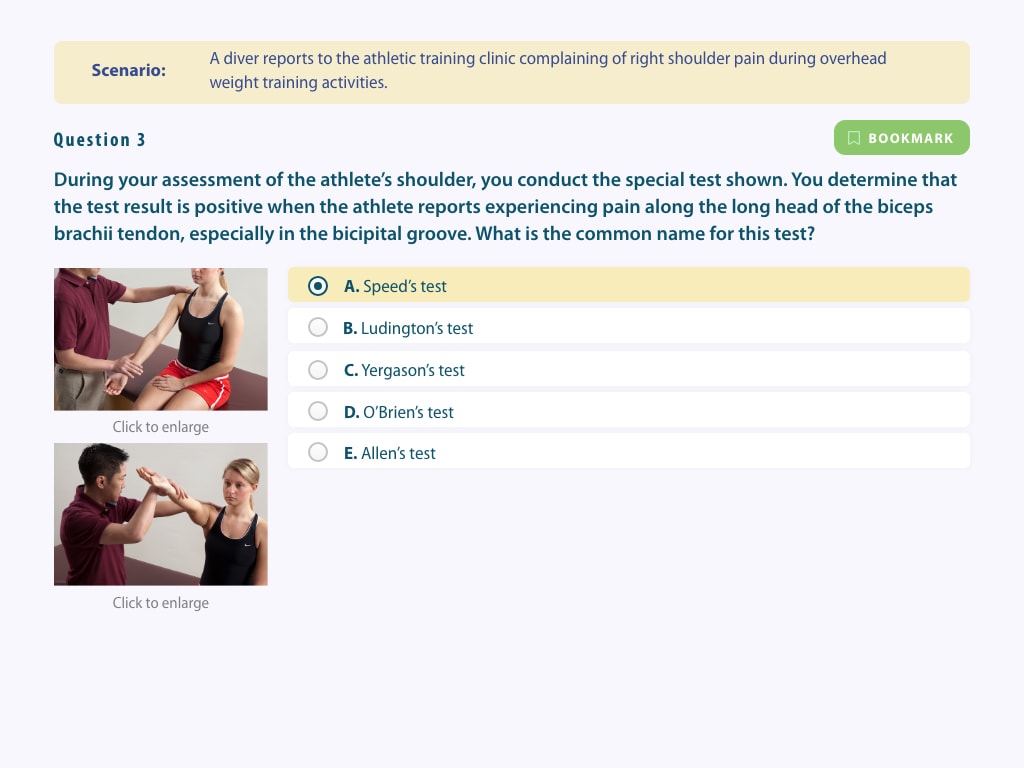
During your assessment of the athlete’s shoulder, you conduct the special test shown. You determine that the test result is positive when the athlete reports experiencing pain along the long head of the biceps brachii tendon, especially in the bicipital groove. What is the common name for this test?

Click to enlarge

Click to enlarge

Speed’s test

Ludington’s test

Yergason’s test

O’Brien’s test

Allen’s test

Scenario:

A diver reports to the athletic training clinic complaining of right shoulder pain during overhead weight training activities.

Question 4

BOOKMARK
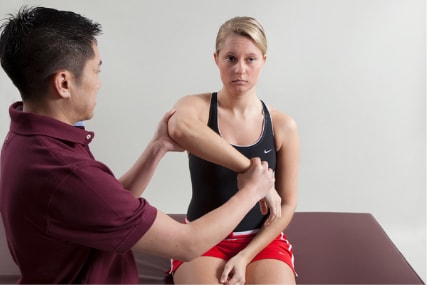
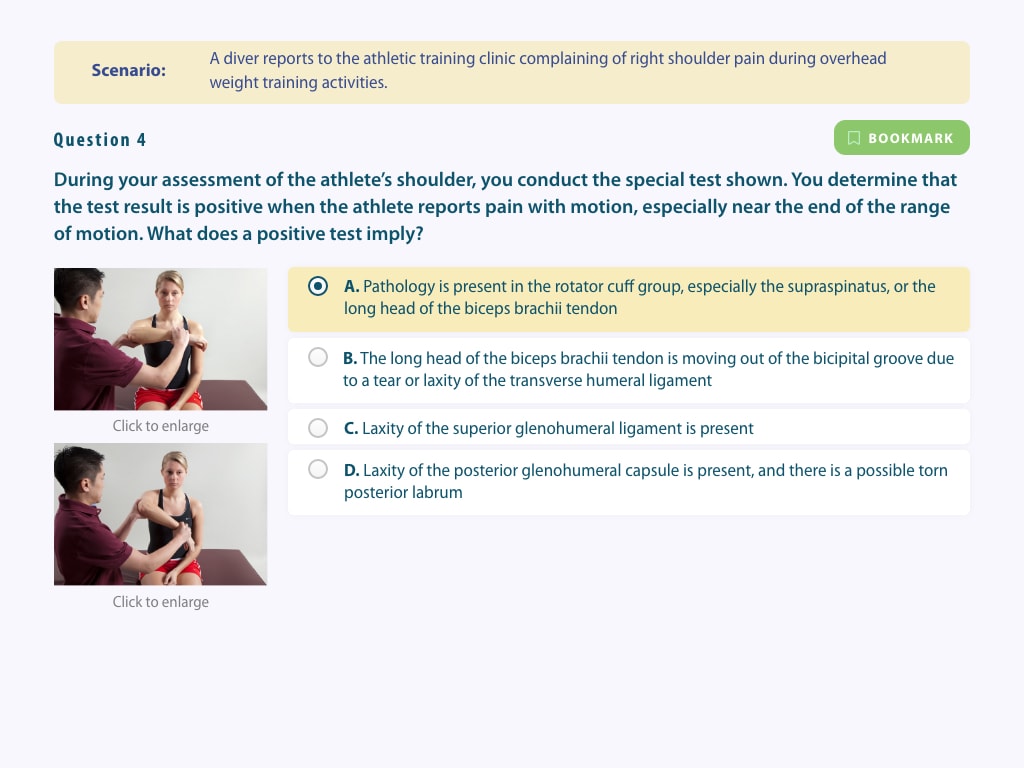
During your assessment of the athlete’s shoulder, you conduct the special test shown. You determine that the test result is positive when the athlete reports pain with motion, especially near the end of the range of motion. What does a positive test imply?

Click to enlarge

Click to enlarge

Pathology is present in the rotator cuff group, especially the supraspinatus, or the long head of the biceps brachii tendon

The long head of the biceps brachii tendon is moving out of the bicipital groove due to a tear or laxity of the transverse humeral ligament

Laxity of the superior glenohumeral ligament is present

Laxity of the posterior glenohumeral capsule is present, and there is a possible torn posterior labrum

Scenario:

A diver reports to the athletic training clinic complaining of right shoulder pain during overhead weight training activities.

Question 5

BOOKMARK
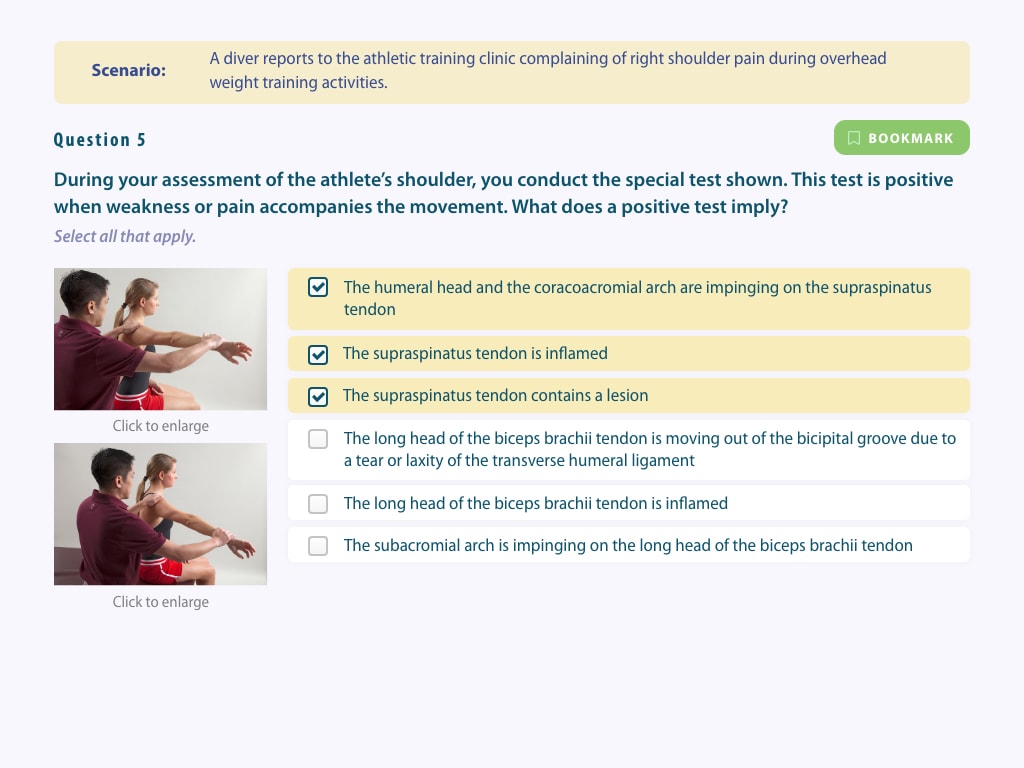
During your assessment of the athlete's shoulder, you conduct the special test shown. This test is positive when weakness or pain accompanies the movement. What does a positive test imply?

Select all that apply.

Click to enlarge

Click to enlarge

The humeral head and the coracoacromial arch are impinging on the supraspinatus tendon

The supraspinatus tendon is inflamed

The supraspinatus tendon contains a lesion

The long head of the biceps brachii tendon is moving out of the bicipital groove due to a tear or laxity of the transverse humeral ligament

The long head of the biceps brachii tendon is inflamed

The subacromial arch is impinging on the long head of the biceps brachii tendon

STUDENT NAME:

DATE COMPLETED:

TIME TRACKED:

Question Number

Your Score

Possible Score

Answer Key

1

0

1

View Answer Key

2

0

1

View Answer Key

3

0

1

View Answer Key

4

0

1

View Answer Key

5

0

3

View Answer Key

Total Points

0

7

Percentage

PRINT RESULTS
NEXT TESTLET