-
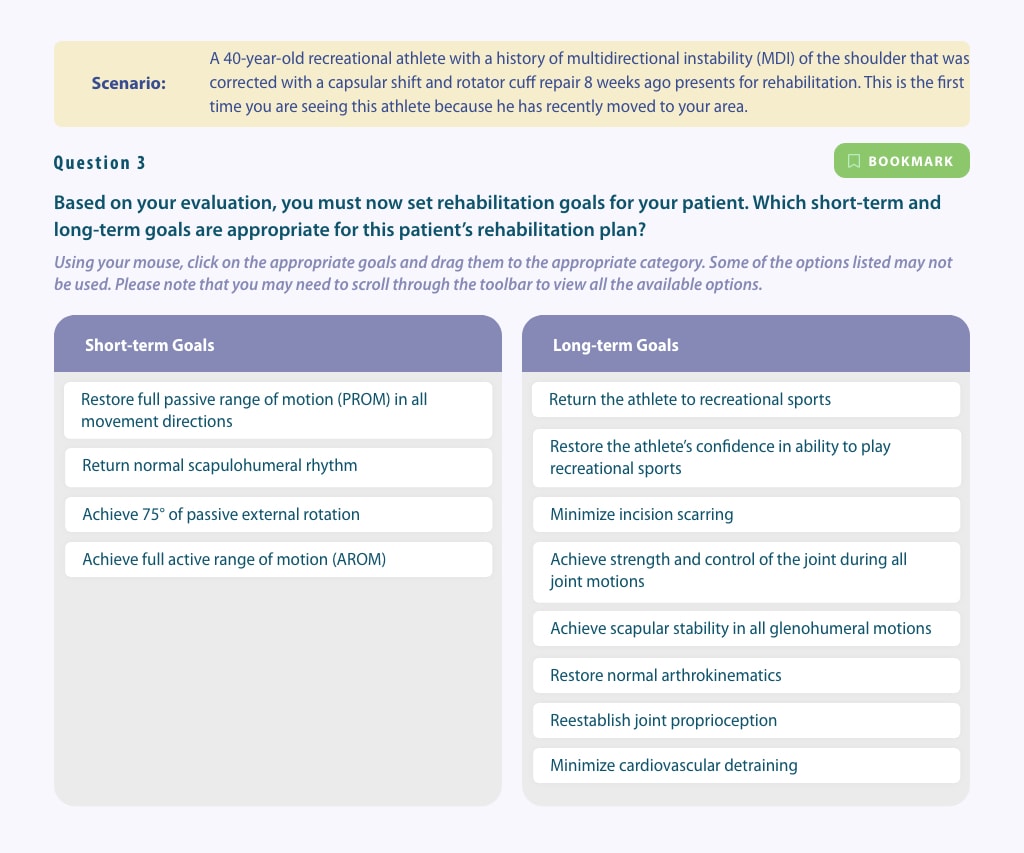
Achieve strength and control of the joint during all joint motions
-
Achieve full active range of motion (AROM)
-
Restore the athlete’s confidence in ability to play recreational sports
-
Restore full passive range of motion (PROM) in all movement directions
-
Eliminate joint pain
-
Minimize incision scarring
-
Minimize cardiovascular detraining
-
Eliminate joint muscle spasm
-
Return normal scapulohumeral rhythm
-
Return the athlete to recreational sports
-
Restore normal arthrokinematics
-
Reestablish joint proprioception
-
Achieve scapular stability in all glenohumeral motions
-
Achieve 75° of passive external rotation
-
Increase contralateral shoulder muscle strength to 25% greater than involved shoulder
-
Improve total body flexibility
Scenario:
A 40-year-old recreational athlete with a history of multidirectional instability (MDI) of the shoulder that was corrected with a capsular shift and rotator cuff repair 8 weeks ago presents for rehabilitation. This is the first time you are seeing this athlete because he has recently moved to your area.
Question 1
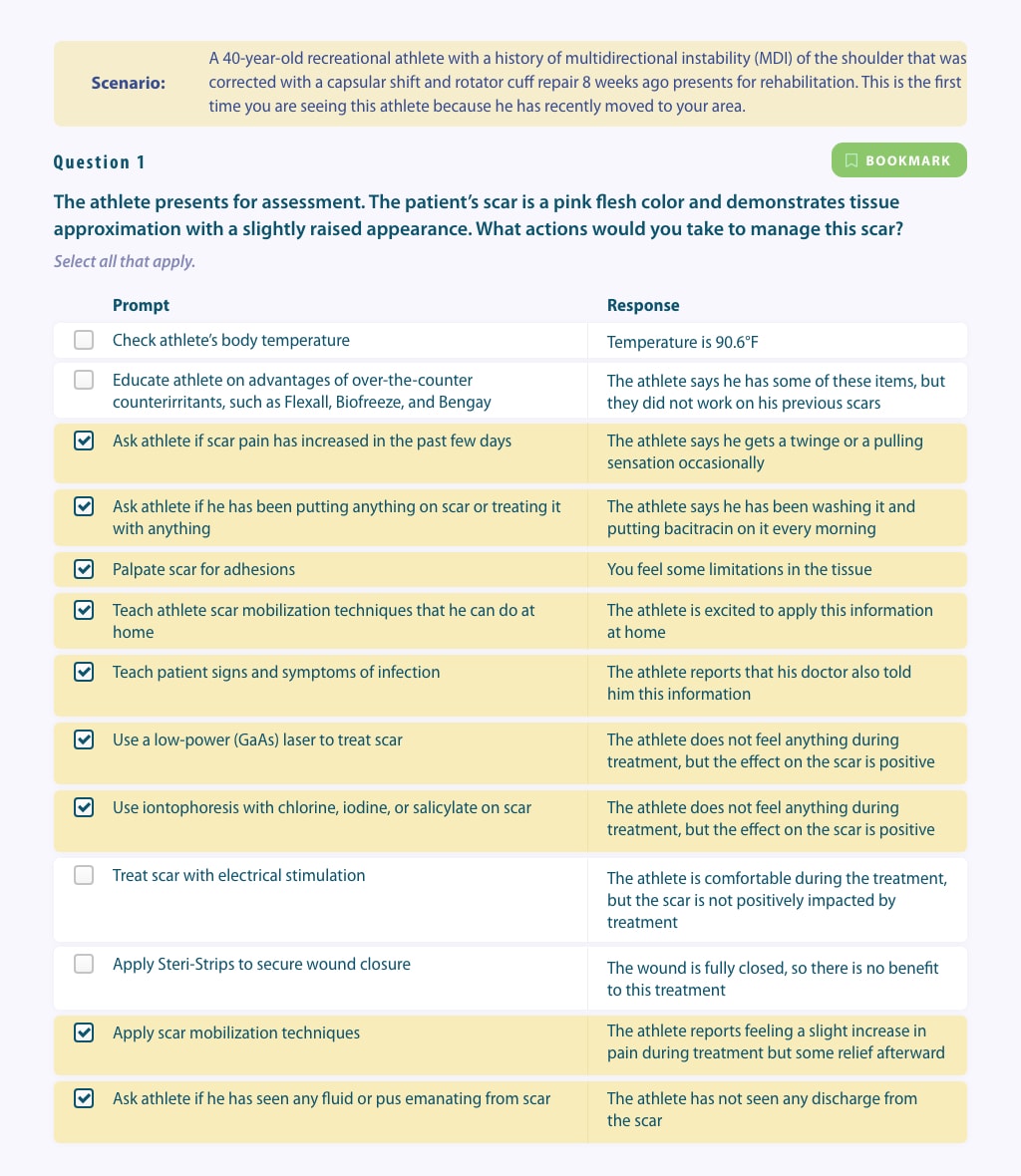
The athlete presents for assessment. The patient’s scar is a pink flesh color and demonstrates tissue approximation with a slightly raised appearance. What actions would you take to manage this scar?
Select all that apply.
Prompt
Response
Check athlete’s body temperature
Temperature is 90.6°F
Educate athlete on advantages of over-the-counter counterirritants, such as Flexall, Biofreeze, and Bengay
The athlete says he has some of these items, but they did not work on his previous scars
Ask athlete if scar pain has increased in the past few days
The athlete says he gets a twinge or a pulling sensation occasionally
Ask athlete if he has been putting anything on scar or treating it with anything
The athlete says he has been washing it and putting bacitracin on it every morning
Palpate scar for adhesions
You feel some limitations in the tissue
Teach athlete scar mobilization techniques that he can do at home
The athlete is excited to apply this information at home
Teach patient signs and symptoms of infection
The athlete reports that his doctor also told him this information
Use a low-power (GaAs) laser to treat scar
The athlete does not feel anything during treatment, but the effect on the scar is positive
Use iontophoresis with chlorine, iodine, or salicylate on scar
The athlete does not feel anything during treatment, but the effect on the scar is positive
Treat scar with electrical stimulation
The athlete is comfortable during the treatment, but the scar is not positively impacted by treatment
Apply Steri-Strips to secure wound closure
The wound is fully closed, so there is no benefit to this treatment
Apply scar mobilization techniques
The athlete reports feeling a slight increase in pain during treatment but some relief afterward
Ask athlete if he has seen any fluid or pus emanating from scar
The athlete has not seen any discharge from the scar
Scenario:
A 40-year-old recreational athlete with a history of multidirectional instability (MDI) of the shoulder that was corrected with a capsular shift and rotator cuff repair 8 weeks ago presents for rehabilitation. This is the first time you are seeing this athlete because he has recently moved to your area.
Question 2
Based on the video taken of the athlete’s involved shoulder performing active glenohumeral joint motion, what should you conclude regarding his scapulohumeral motion?
Select all that apply.
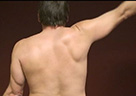
Click to enlarge
There is no motion of the scapula in the first 30° of glenohumeral motion, indicating normal scapulohumeral rhythm
There is no motion in the scapula in the first 30° of glenohumeral motion, indicating a possible frozen shoulder
As the glenohumeral joint is abducting from 30° to 90°, the scapula is abducting 1° for every 1° of glenohumeral motion, indicating normal scapulohumeral rhythm
As the glenohumeral joint is abducting from 30° to 90°, the scapula is abducting 1° for every 2° of glenohumeral motion, indicating normal scapulohumeral rhythm
As the glenohumeral joint abducts from 90°-full abduction, the scapula is abducting 1° for every 2° of glenohumeral motion, indicating normal scapulohumeral rhythm
As the glenohumeral joint abducts from 90°-full abduction, the scapula fails to abduct, indicating limited or restricted scapulohumeral rhythm
Scenario:
A 40-year-old recreational athlete with a history of multidirectional instability (MDI) of the shoulder that was corrected with a capsular shift and rotator cuff repair 8 weeks ago presents for rehabilitation. This is the first time you are seeing this athlete because he has recently moved to your area.
Question 3
Based on your evaluation, you must now set rehabilitation goals for your patient. Which short-term and long-term goals are appropriate for this patient’s rehabilitation plan?
Using your mouse, click on the appropriate goals and drag them to the appropriate category. Some of the options listed may not be used. Please note that you may need to scroll through the toolbar to view all the available options.
Short-term Goals
Long-term Goals
Scenario:
A 40-year-old recreational athlete with a history of multidirectional instability (MDI) of the shoulder that was corrected with a capsular shift and rotator cuff repair 8 weeks ago presents for rehabilitation. This is the first time you are seeing this athlete because he has recently moved to your area.
Question 4
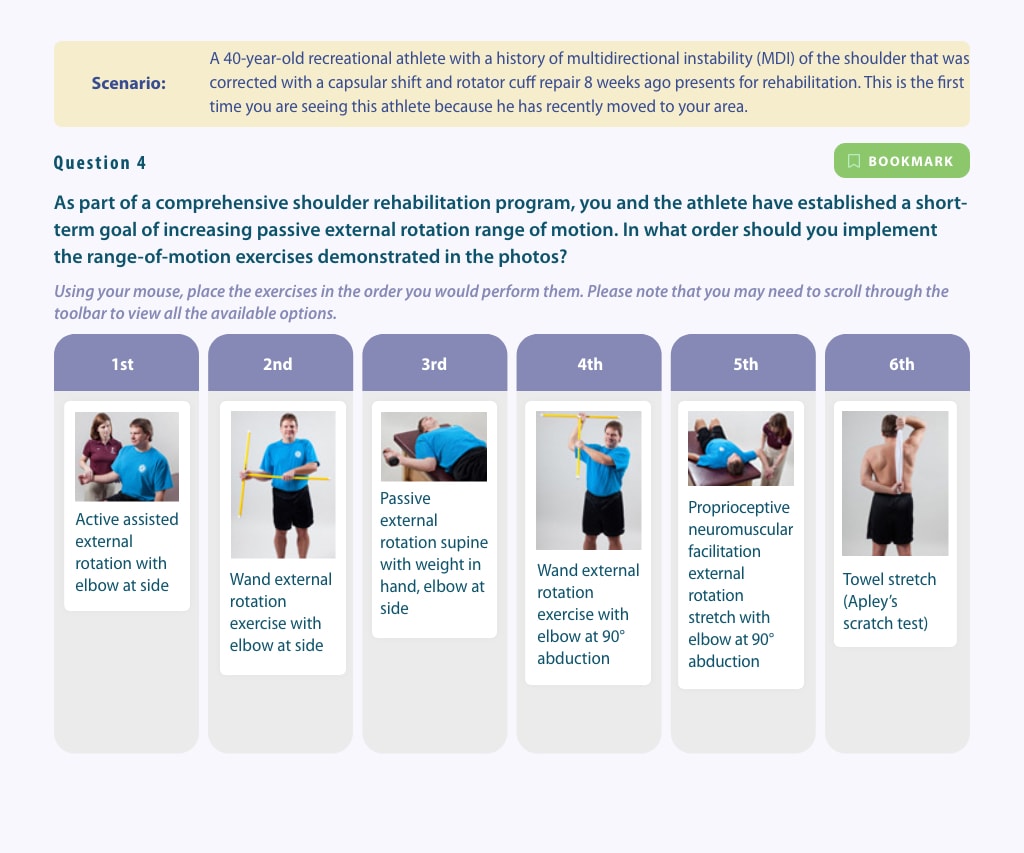
As part of a comprehensive shoulder rehabilitation program, you and the athlete have established a short-term goal of increasing passive external rotation range of motion. In what order should you implement the range-of-motion exercises demonstrated in the photos?
Using your mouse, place the exercises in the order you would perform them. Please note that you may need to scroll through the toolbar to view all the available options.
-

Proprioceptive neuromuscular facilitation external rotation stretch with elbow at 90° abduction
-
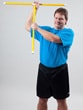
Wand external rotation exercise with elbow at 90° abduction
-
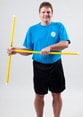
Wand external rotation exercise with elbow at side
-

Active assisted external rotation with elbow at side
-

Passive external rotation supine with weight in hand, elbow at side
-
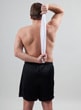
Towel stretch (Apley's scratch test)
1st
2nd
3rd
4th
5th
6th
Scenario:
A 40-year-old recreational athlete with a history of multidirectional instability (MDI) of the shoulder that was corrected with a capsular shift and rotator cuff repair 8 weeks ago presents for rehabilitation. This is the first time you are seeing this athlete because he has recently moved to your area.
Question 5
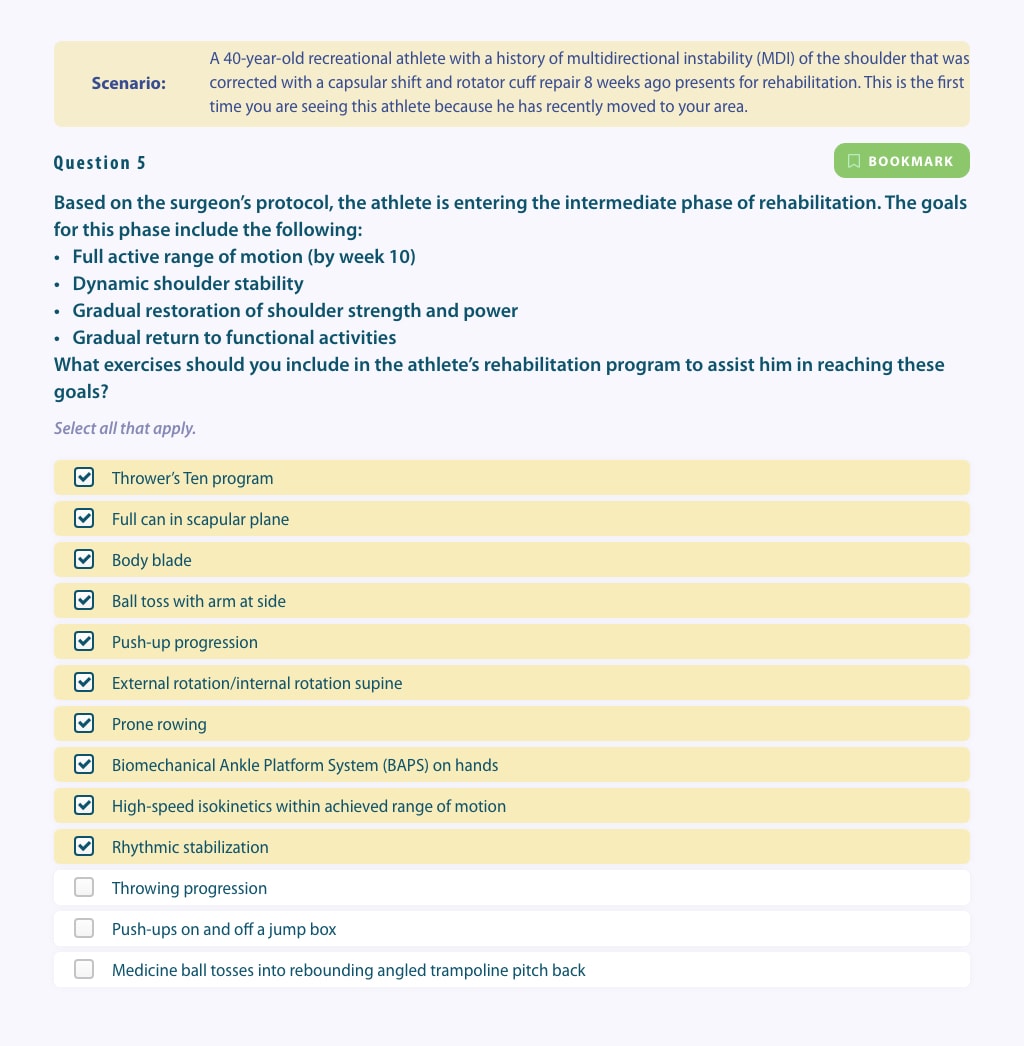
Based on the surgeon’s protocol, the athlete is entering the intermediate phase of rehabilitation. The goals for this phase include the following:
• Full active range of motion (by week 10)
• Dynamic shoulder stability
• Gradual restoration of shoulder strength and power
• Gradual return to functional activities
What exercises should you include in the athlete’s rehabilitation program to assist him in reaching these goals?
• Full active range of motion (by week 10)
• Dynamic shoulder stability
• Gradual restoration of shoulder strength and power
• Gradual return to functional activities
What exercises should you include in the athlete’s rehabilitation program to assist him in reaching these goals?
Select all that apply.
Thrower’s ten program
Full can in scapular plane
Body blade
Ball toss with arm at side
Push-up progression
External rotation/internal rotation supine
Prone rowing
Biomechanical ankle platform system (BAPS) on hands
High-speed isokinetics within achieved range of motion
Rhythmic stabilization
Throwing progression
Push-ups on and off a jump box
Medicine ball tosses into rebounding angled trampoline pitch back
|
Question Number |
Your Score |
Possible Score |
Answer Key |
|---|---|---|---|
|
1 |
0 |
9 |
|
|
2 |
0 |
3 |
|
|
3 |
0 |
12 |
|
|
4 |
0 |
6 |
|
|
5 |
0 |
10 |
|
|
Total Points |
0 |
40 |
|
|
Percentage |
|
||