-
Moving bone with a concave surface
-
Moving bone with a convex surface
-
Stationary bone with a convex surface
-
Stationary bone with a concave surface
Scenario:
A baseball coach who is 6 weeks status post rotator cuff repair is rehabilitating in your athletic training clinic.
Question 1
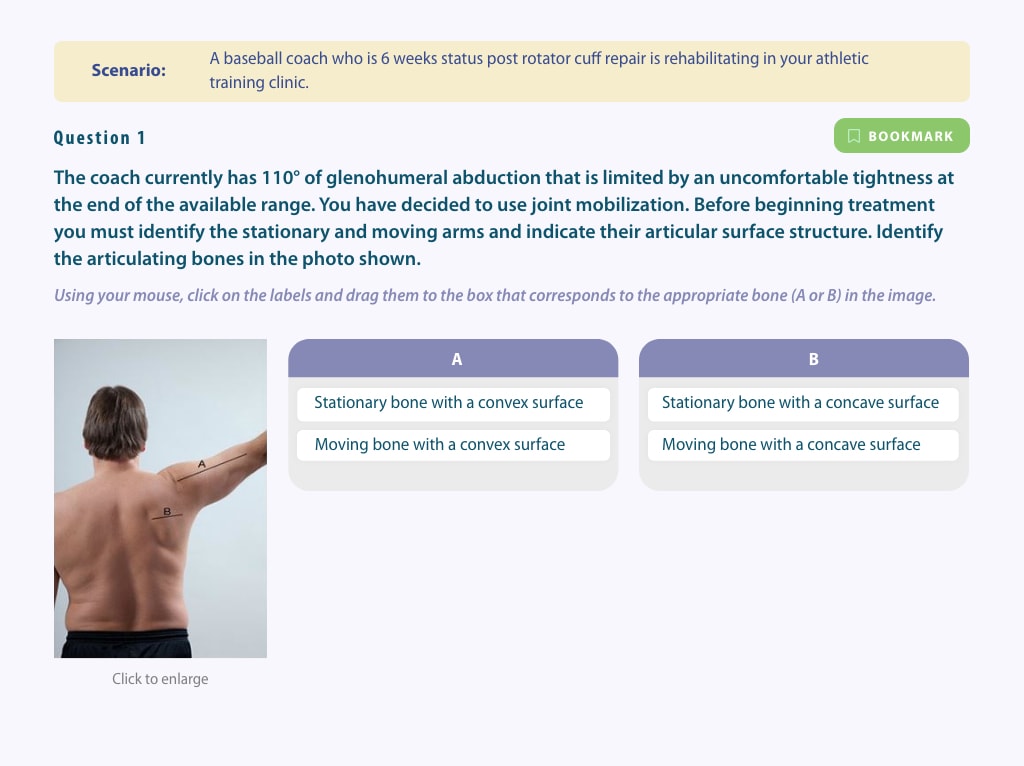
The coach currently has 110° of glenohumeral abduction that is limited by an uncomfortable tightness at the end of the available range. You have decided to use joint mobilization. Before beginning treatment you must identify the stationary and moving arms and indicate their articular surface structure. Identify the articulating bones in the photo shown.
Using your mouse, click on the labels and drag them to the box that corresponds to the appropriate bone (A or B) in the image.

Click to enlarge
A
B
Scenario:
A baseball coach who is 6 weeks status post rotator cuff repair is rehabilitating in your athletic training clinic.
Question 2
The coach currently has 110° of glenohumeral abduction that is limited by an uncomfortable tightness at the end of the available range. You have decided to use joint mobilization. Before beginning treatment, you must determine the direction of the joint restriction.
First, use your mouse and select the appropriate arrow from the toolbar that indicates the direction of the joint restriction. Only one arrow can be selected. Second, click the appropriate location on the image to indicate the correct response. You may reposition the circle until you are satisfied with its placement. When you have completed your assessment, click the SUBMIT RESPONSE button to submit the question for scoring.


Scenario:
A baseball coach who is 6 weeks status post rotator cuff repair is rehabilitating in your athletic training clinic.
Question 3
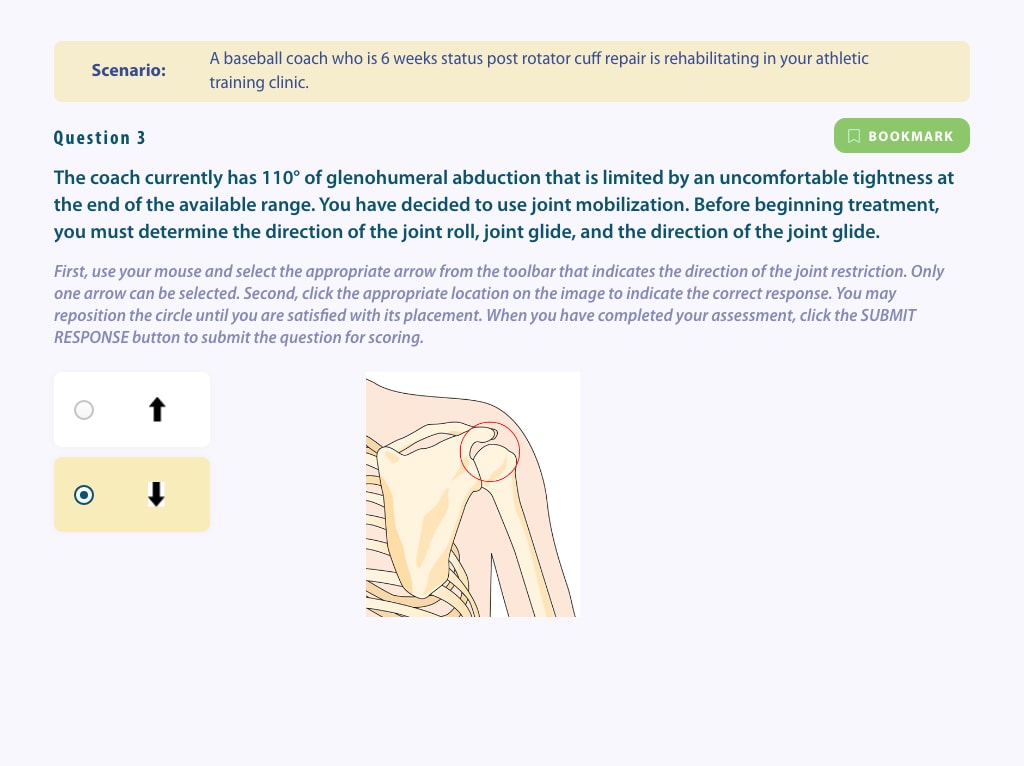
The coach currently has 110° of glenohumeral abduction that is limited by an uncomfortable tightness at the end of the available range. You have decided to use joint mobilization. Before beginning treatment, you must determine the direction of the joint glide.
First, use your mouse and select the appropriate arrow from the toolbar that indicates the direction of the joint restriction. Only one arrow can be selected. Second, click the appropriate location on the image to indicate the correct response. You may reposition the circle until you are satisfied with its placement. When you have completed your assessment, click the SUBMIT RESPONSE button to submit the question for scoring.
Scenario:
A baseball coach who is 6 weeks status post rotator cuff repair is rehabilitating in your athletic training clinic.
Question 4
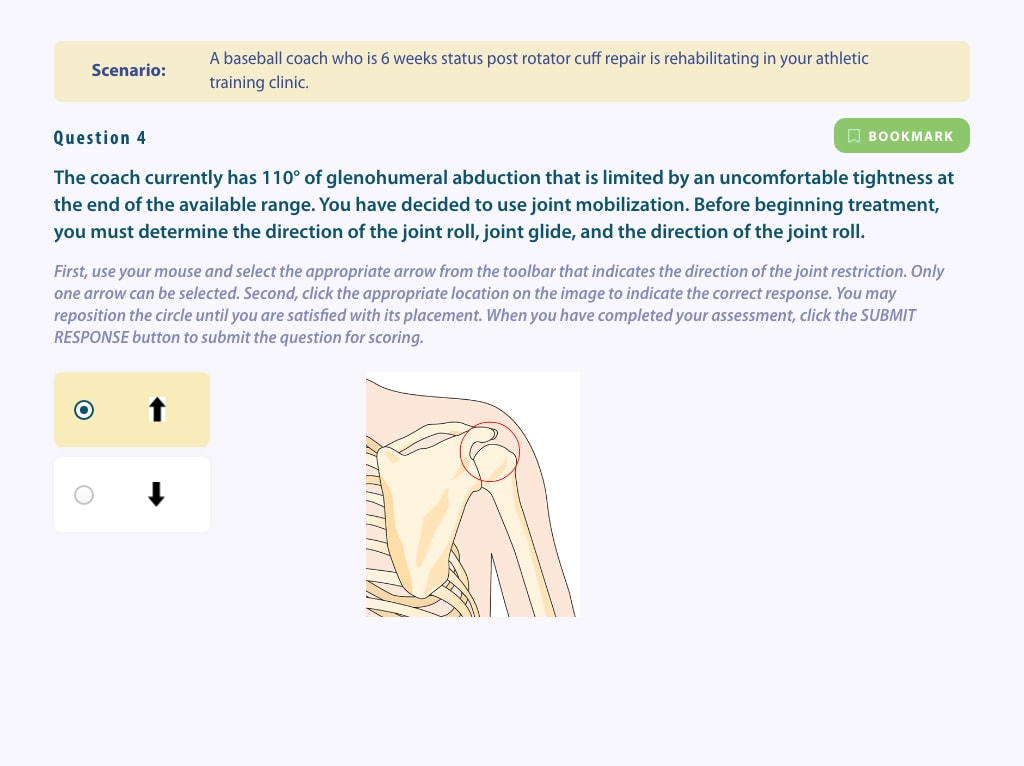
The coach currently has 110° of glenohumeral abduction that is limited by an uncomfortable tightness at the end of the available range. You have decided to use joint mobilization. Before beginning treatment, you must determine the direction of the joint roll.
First, use your mouse and select the appropriate arrow from the toolbar that indicates the direction of the joint restriction. Only one arrow can be selected. Second, click the appropriate location on the image to indicate the correct response. You may reposition the circle until you are satisfied with its placement. When you have completed your assessment, click the SUBMIT RESPONSE button to submit the question for scoring.
Scenario:
A baseball coach who is 6 weeks status post rotator cuff repair is rehabilitating in your athletic training clinic.
Question 5
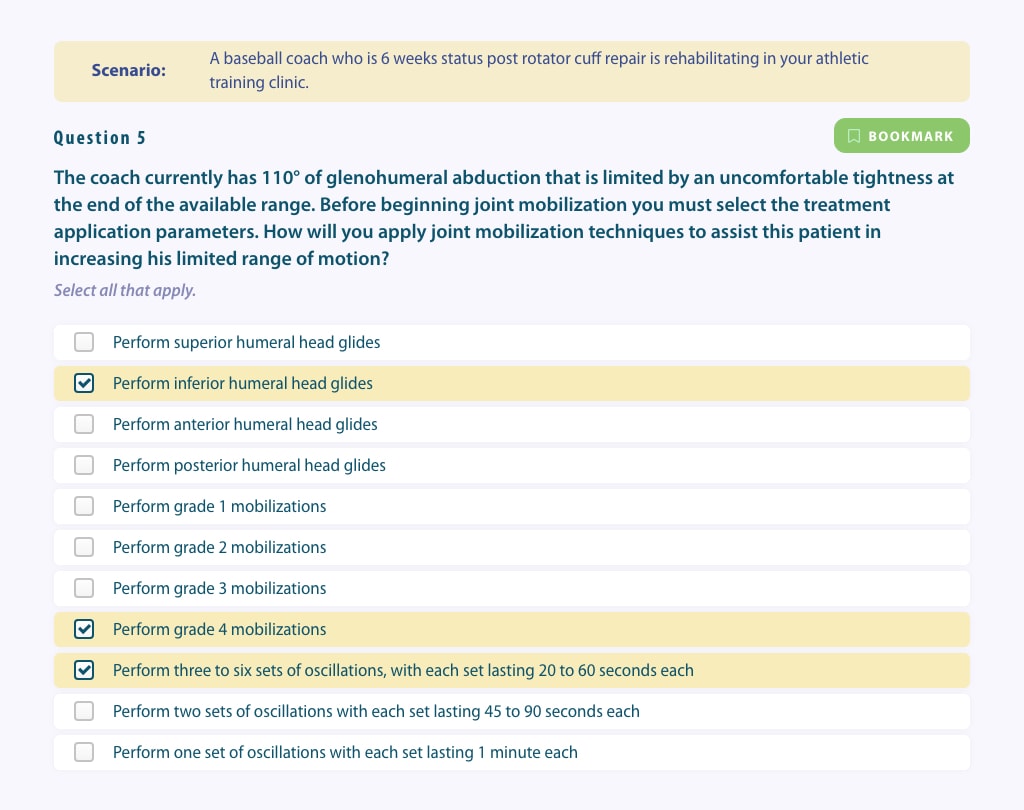
The coach currently has 110° of glenohumeral abduction that is limited by an uncomfortable tightness at the end of the available range. Before beginning joint mobilization you must select the treatment application parameters. How will you apply joint mobilization techniques to assist this patient in increasing his limited range of motion?
Select all that apply.
Perform superior humeral head glides
Perform inferior humeral head glides
Perform anterior humeral head glides
Perform posterior humeral head glides
Perform grade 1 mobilizations
Perform grade 2 mobilizations
Perform grade 3 mobilizations
Perform grade 4 mobilizations
Perform three to six sets of oscillations, with each set lasting 20 to 60 seconds each
Perform two sets of oscillations with each set lasting 45 to 90 seconds each
Perform one set of oscillations with each set lasting 1 minute each
Scenario:
A baseball coach who is 6 weeks status post rotator cuff repair is rehabilitating in your athletic training clinic.
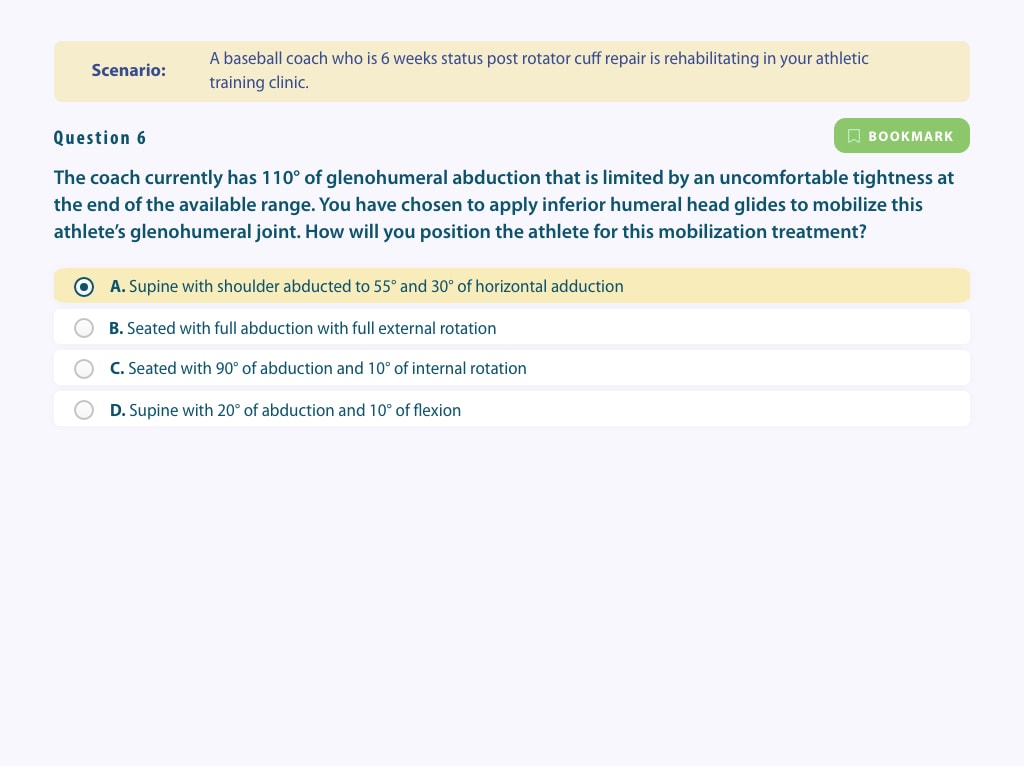
Question 6
The coach currently has 110° of glenohumeral abduction that is limited by an uncomfortable tightness at the end of the available range. You have chosen to apply inferior humeral head glides to mobilize this athlete’s glenohumeral joint. How will you position the athlete for this mobilization treatment?
Supine with shoulder abducted to 55° and 30° of horizontal adduction
Seated with full abduction with full external rotation
Seated with 90° of abduction and 10° of internal rotation
Supine with 20° of abduction and 10° of flexion
Scenario:
A baseball coach who is 6 weeks status post rotator cuff repair is rehabilitating in your athletic training clinic.
Question 7
The coach currently has 110° of glenohumeral abduction that is limited by an uncomfortable tightness at the end of the available range. You have chosen to apply humeral head glides to treat this patient. What steps should you take to administer this treatment?
Select only the steps that are appropriate. Place your selection in the order in which you would perform them. Some of the steps listed may not be used. Please note that you may need to scroll through the toolbar to view all the available options.
-
Perform grade 1 or grade 2 oscillations to relieve pain after treatment
-
Position athlete with the joint in open-packed position
-
Create and maintain joint traction perpendicular to the treatment plane
-
Explain the purpose of the treatment and expected sensations
-
Determine the appropriate treatment plane
-
Position one hand on the distal humerus and one hand providing stabilization
-
Ensure that the athlete is relaxed and ready for treatment
-
Ask athlete to take a deep breath and hold it throughout treatment
-
Screen athlete for contraindications to joint mobilizations
-
Apply oscillations in the direction of normal humeral glide
-
Perform mobilization treatment
-
Perform grade 4 oscillations to facilitate relaxation
-
Position athlete in close-packed position
-
Create and maintain joint traction parallel to the treatment plane
-
Place one hand at the humeral neck and one hand on the superior aspect of the scapula, providing stabilization
-
Perform grade 1 or grade 2 oscillations to facilitate relaxation
-
Apply oscillations in the direction of normal humeral roll
1
2
3
4
5
6
7
8
9
10
11
|
Question Number |
Your Score |
Possible Score |
Answer Key |
|---|---|---|---|
|
1 |
0 |
4 |
|
|
2 |
0 |
2 |
|
|
3 |
0 |
2 |
|
|
4 |
0 |
2 |
|
|
5 |
0 |
3 |
|
|
6 |
0 |
1 |
|
|
7 |
0 |
11 |
|
|
Total Points |
0 |
25 |
|
|
Percentage |
|
||